 Kelpdao
 rsETH adds EigenLayer restaking exposure to a liquid Ethereum staking position
Kelpdao rsETH adds EigenLayer restaking exposure to Ethereum staking through a liquid receipt token. Liquid staking tokens represent the staking layer; Kelp's receipt also connects that exposure to operator delegation and additional service commitments. Both formats can support DeFi use where applications accept them. Their reward sources, valuation units and exit conditions differ. Restaking can add rewards alongside extra loss conditions, while bridging or borrowing introduces separate dependencies.
Ethereum staking and delegated restaking
When a liquid staking token enters Kelp's restaking system, its existing Ethereum staking exposure becomes part of a position that also supports EigenLayer services. Ethereum validators support Ethereum consensus. Restaking adds delegated security commitments to other services. A liquid staking token (LST) and a liquid restaking token (LRT) describe different relationships to the underlying assets.
rsETH represents Kelp's managed restaking position while retaining a transferable token format. That format makes the position usable outside the contracts that hold its backing. Liquidity and security exposure describe separate properties: a receipt can trade while its backing remains committed to staking and restaking. Both formats retain Ethereum staking risks.
The deposit pool and the issued receipt
Kelp's deposit pool connects an accepted asset to rsETH issuance through exchange-rate accounting, so the receipt quantity depends on the deposited asset's value and the rsETH rate.
Native ETH and supported LSTs provide different entry assets for that relationship. Supported deposit assets include ETH, ETHx and stETH, subject to the selected network and supported route. Those choices don't make every Ethereum staking token eligible. Asset support belongs to the actual deposit configuration. An LST deposit moves that token into Kelp's contracts and produces an rsETH receipt for the resulting position. The original deposit isn't also an independently spendable wallet balance. Input and output token counts use different units, so a smaller receipt count doesn't by itself indicate a loss.
Node delegators and service commitments
Once assets enter Kelp's management, node delegators connect the deposited backing to EigenLayer restaking and operator delegation, while rsETH remains the holder's liquid representation of that managed position.
Operator delegation
Node delegator contracts deposit supported LSTs into EigenLayer strategies. They can also stake native ETH through EigenPods, which connect Ethereum validator balances to restaking. Each node delegator can delegate its restaked shares to one operator. Operators participate in services that use that security. An actively validated service, or AVS, is a service that uses EigenLayer's restaking framework. Operator delegation establishes who handles those service commitments; it doesn't make the rsETH holder the operator.
Rewards and potential losses
Service rewards
EigenLayer services can distribute rewards to eligible operators and restakers. Participation, delegated stake and the applicable reward arrangement determine entitlement.
Slashing exposure
Slashable stake allocated to a service's operator set can face that service's slashing conditions. Those conditions add potential losses to the restaking layer. They don't describe an identical penalty for every operator, strategy or rsETH deployment. The relevant exposure follows the actual delegation and allocation.
Receipt balances and ETH-denominated value
When rsETH represents assets through an exchange rate, the token balance and its ETH-denominated value answer different questions about the position, just as different LST accounting formats require their own units. The rsETH exchange rate expresses the ETH-denominated value represented by each rsETH token. A wallet balance counts receipts. Neither number alone establishes the output from a market sale.
Kelp's oracle calculates the rsETH exchange rate from ETH-valued backing and rsETH supply, accounting for protocol fees. Rewards included in that backing can increase the value per receipt when the rate updates, without changing the holder's rsETH balance. Assets can occupy the deposit pool, node delegators, EigenLayer strategies or withdrawal-related contracts. Their inclusion in backing accounting doesn't establish immediate availability for an exit. A quoted conversion also needs a clear direction: ETH per rsETH differs from rsETH per ETH.
A token balance reconciled with an ETH estimate
In this hypothetical comparison, a reader holds 3.75 rsETH and observes an exchange rate of 1.08 ETH per rsETH. Both inputs are illustrative. The reader wants to compare the position with an LST using the same underlying unit.
Multiplying the balance by the rate gives 3.75 rsETH × 1.08 ETH per rsETH = 4.05 ETH. The rsETH units cancel, leaving an ETH-denominated estimate. The position still contains 3.75 rsETH. The calculation doesn't establish that 4.05 ETH has entered the wallet or that an LST with a different token count is worth less.
The LST comparison requires its own ETH conversion before the values become comparable. Changing the assumed rsETH rate changes the estimate proportionally. A redemption fee or a market sale's price impact changes actual exit proceeds separately, so the calculated 4.05 ETH remains a valuation before those costs.
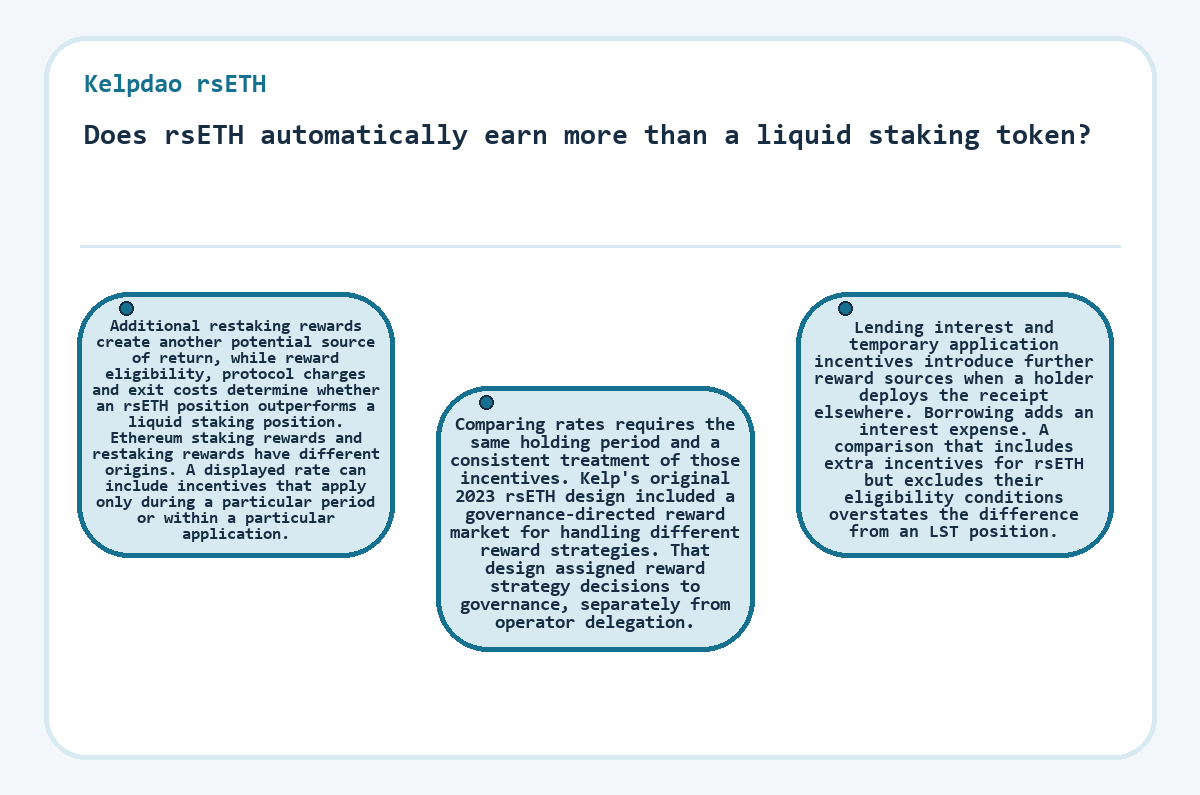
Does rsETH automatically earn more than a liquid staking token?
Additional restaking rewards create another potential source of return, while reward eligibility, protocol charges and exit costs determine whether an rsETH position outperforms a liquid staking position.
Ethereum staking rewards and restaking rewards have different origins. A displayed rate can include incentives that apply only during a particular period or within a particular application. Comparing rates requires the same holding period and a consistent treatment of those incentives. Kelp's original 2023 rsETH design included a governance-directed reward market for handling different reward strategies. That design assigned reward strategy decisions to governance, separately from operator delegation. Lending interest and temporary application incentives introduce further reward sources when a holder deploys the receipt elsewhere. Borrowing adds an interest expense. A comparison that includes extra incentives for rsETH but excludes their eligibility conditions overstates the difference from an LST position.
Token liquidity and DeFi integration
Where an application accepts the correct token on the selected network, rsETH can support lending or trading while its underlying assets remain within the restaking system. LSTs can also support DeFi use, so composability alone doesn't distinguish the two categories. Kelp integrates with lending and trading applications, including Aave. Each market applies its own collateral rules and liquidity constraints. A liquid token remains subject to the application that holds it, especially when it supports outstanding debt.
Market sales and protocol redemption
If a holder sells a liquid receipt, market liquidity determines the trade's execution, while protocol redemption follows the contracts and conditions governing the underlying position. Redemption needs the protocol's supported withdrawal machinery and assets. The presence of an exchange-rate valuation doesn't make a market buyer pay that valuation.
This distinction applies to both LSTs and rsETH. Each LST retains its own redemption terms. A token's market liquidity can provide an earlier exit from holding the receipt, with price impact and transaction costs affecting proceeds. Thin liquidity can make that exit expensive. Redemption can involve waiting for assets to become available. Transferability therefore doesn't establish immediate conversion into the desired asset at the protocol rate.
Withdrawal contracts and the returned asset
When an rsETH holder uses Kelp's redemption path, withdrawal contracts connect the liquid receipt to a supported underlying asset, with the chosen mode determining the applicable conditions. Kelp's rsETH redemption routes return ETH, ETHx or stETH only on Ethereum mainnet. The LRT Withdrawal Manager and LRT Unstaking Vault belong to the machinery around that conversion. They have a different purpose from the token contract, which records the liquid receipt itself.
Kelp's Restaking Guide describes instant withdrawal as immediate with a 0.5% fee. Standard withdrawal has no protocol withdrawal fee and a 15-21 day wait in that guide. Those terms belong to the selected redemption route; they don't define every trade or lending withdrawal involving rsETH. Receiving an LST returns exposure in that LST's units, while receiving ETH returns the native asset. Any further conversion follows the returned asset's own mechanism or a separate market trade. A fair comparison with holding an LST directly includes these extra redemption dependencies.
Core contracts and bridge verification
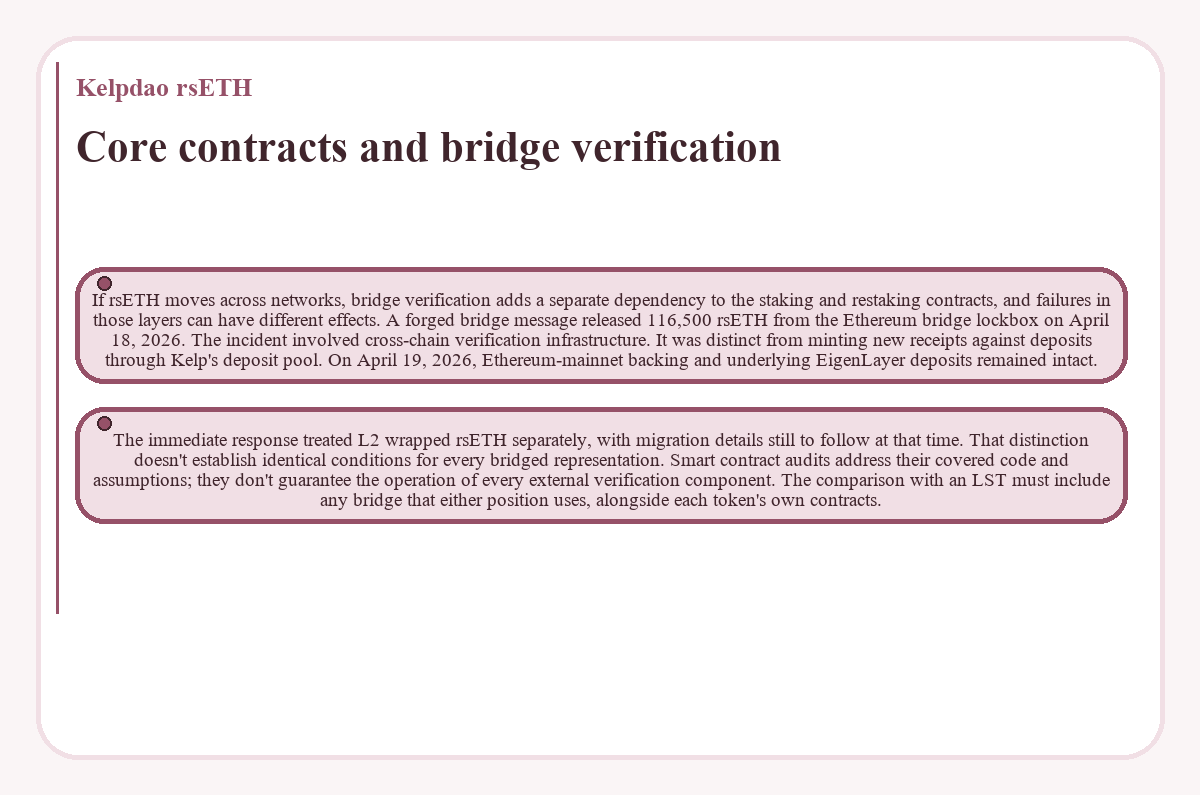
If rsETH moves across networks, bridge verification adds a separate dependency to the staking and restaking contracts, and failures in those layers can have different effects. A forged bridge message released 116,500 rsETH from the Ethereum bridge lockbox on April 18, 2026. The incident involved cross-chain verification infrastructure. It was distinct from minting new receipts against deposits through Kelp's deposit pool.
On April 19, 2026, Ethereum-mainnet backing and underlying EigenLayer deposits remained intact. The immediate response treated L2 wrapped rsETH separately, with migration details still to follow at that time. That distinction doesn't establish identical conditions for every bridged representation. Smart contract audits address their covered code and assumptions; they don't guarantee the operation of every external verification component. The comparison with an LST must include any bridge that either position uses, alongside each token's own contracts.
Network support and recovery boundaries
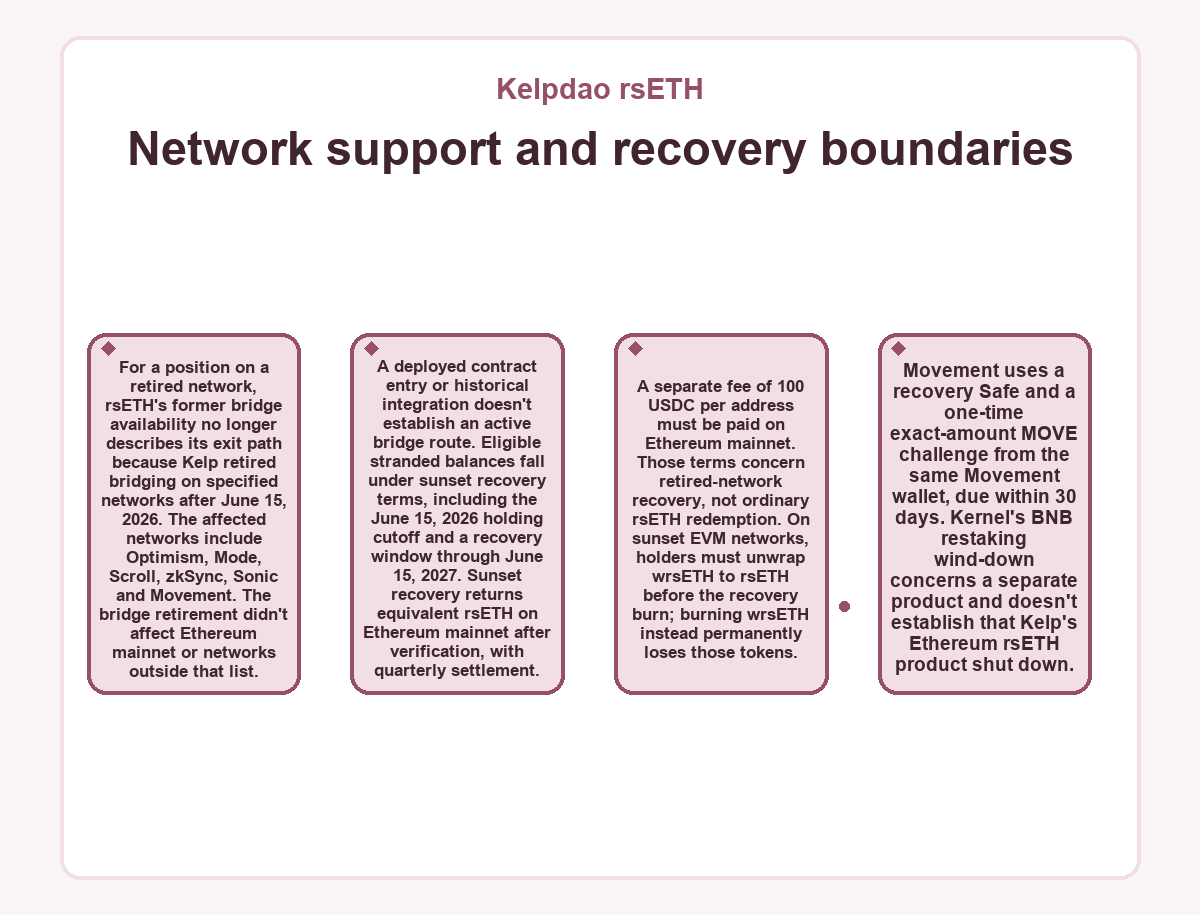
For a position on a retired network, rsETH's former bridge availability no longer describes its exit path because Kelp retired bridging on specified networks after June 15, 2026. The affected networks include Optimism, Mode, Scroll, zkSync, Sonic and Movement. The bridge retirement didn't affect Ethereum mainnet or networks outside that list. A deployed contract entry or historical integration doesn't establish an active bridge route.
Eligible stranded balances fall under sunset recovery terms, including the June 15, 2026 holding cutoff and a recovery window through June 15, 2027. Sunset recovery returns equivalent rsETH on Ethereum mainnet after verification, with quarterly settlement. A separate fee of 100 USDC per address must be paid on Ethereum mainnet. Those terms concern retired-network recovery, not ordinary rsETH redemption. On sunset EVM networks, holders must unwrap wrsETH to rsETH before the recovery burn; burning wrsETH instead permanently loses those tokens. Movement uses a recovery Safe and a one-time exact-amount MOVE challenge from the same Movement wallet, due within 30 days. Kernel's BNB restaking wind-down concerns a separate product and doesn't establish that Kelp's Ethereum rsETH product shut down.
Configuration and control of the restaked position
When a holder chooses rsETH for managed restaking exposure, protocol configuration governs supported assets and backing management, while holding an LST outside restaking retains that LST's own staking relationship. Kelp's contracts separate roles for managing assets, delegation and configuration. Receipt ownership doesn't give its holder control over every operator or reward strategy. The additional restaking relationship can simplify participation through a liquid token, with those management permissions remaining part of the position's dependencies.
Things people ask about Kelpdao rsETH
Can a contract that accepts stETH automatically accept rsETH?
A contract must explicitly support rsETH; accepting stETH doesn't establish that compatibility. ERC-20 interfaces describe token operations, while each application identifies the assets and valuation mechanisms that it accepts. A lending integration also needs appropriate collateral configuration for its particular market. Changing the receipt changes the asset that the contract handles, even when both positions ultimately have Ethereum staking exposure.
What does an rsETH mint establish about EigenLayer delegation?
An rsETH mint establishes receipt issuance, without establishing that the newly deposited backing has already reached a particular EigenLayer operator. Kelp separates deposit acceptance, movement into node delegators and delegation of restaked shares. The token issuance event doesn't report every underlying allocation. Receipt ownership and the operator commitments behind it describe different parts of the position.
When do ETH rewards in the fee receiver enter the deposit pool's accounting?
ETH rewards waiting in Kelp's fee receiver enter deposit-pool asset accounting when the receiver transfers those funds into the pool. A reward claim and its inclusion in the backing calculation describe different states. An rsETH valuation comparison can therefore differ from a display of rewards awaiting transfer. That distinction concerns accounting location and doesn't turn a pending reward into an immediately spendable wallet balance.
Do rsETH restaking rewards always originate in ETH?
Restaking rewards can originate in ERC-20 tokens other than native ETH. EigenLayer services distribute reward tokens, and Kelp's node delegators connect claims to protocol reward handling. An ETH-denominated return describes a valuation unit. It doesn't establish that every underlying reward payment arrived in ETH or that the holder receives each original reward token directly.
Does receiving an Aave aToken change rsETH into a different restaking asset?
An Aave aToken represents a lending-market supply position in its underlying asset. In a market that accepts rsETH, supplying it creates an additional receipt relationship while rsETH remains the underlying restaking token. Aave's supply interest and market constraints belong to the lending layer. Redeeming the aToken withdraws the supplied asset subject to available liquidity and collateral conditions; it doesn't perform Kelp's conversion from rsETH into ETH or an LST.
Are agETH and rsETH interchangeable liquid receipts?
agETH and rsETH represent different managed positions. agETH is the Airdrop Gain Vault token, while rsETH represents Kelp's liquid restaking position. Gain deploys vault assets across reward strategies and issues vault share tokens. Those strategies add exposure beyond the receipt's liquid format. Each token follows the management and redemption conditions of its own position.